Uncle Big
The Sky Is EverywhereUncle Big is Gram’s brother, Paige Walker’s brother, and Lennie Walker’s uncle: an arborist and devoted plant expert whose eccentric projects give the Walker household both comedy and a form of care. His booming manner can make an ordinary remark sound momentous, but when grief enters the house, he responds with food, physical reassurance, and the steady insistence that the family has to endure it together.
Identity and Family Role
Lennie’s introduction to Uncle Big emphasizes his expertise with plants and his expansive, unconventional character. Gram turns to him when Lennie’s houseplant develops a serious condition; because Gram has long treated the plant as a reflection of Lennie’s emotional, spiritual, and physical well-being, the exchange makes his judgment about the plant carry concern for Lennie as well. Both adults look toward her as they discuss its prospects, linking his practical knowledge to the family’s way of registering her distress.
Uncle Big is also Paige Walker’s brother. He has experienced repeated romantic upheaval: by the time of Bailey’s death, he has been married five times, and his beloved fifth wife has left him. Gram insists that he move into the family home, worrying that in his lovesick state he will neglect himself. His presence in the household is therefore not simply comic or eccentric; he, too, is someone whom the family takes in and looks after.
Plant Expertise and Eccentric Projects
His interest in plants extends beyond ordinary arboriculture. He builds pyramid replicas based on what he believes are hidden mathematical properties in the Egyptian pyramids, hoping they can prolong the life of cut flowers and fruit or revive dead insects. In earlier attempts, Bailey, Lennie, and Uncle Big searched the house for dead spiders and flies, then checked the structures for signs of resurrection. None appeared. When he becomes especially upset, however, he returns to the experiment with renewed conviction, adding an electrically charged coil beneath each pyramid because he believes that a missing element explains the earlier failures.
The episode captures the mixture of persistence and absurdity that marks his characterization. His confidence in the pyramids’ powers is never confirmed, but his projects make his distress visible: when emotion overwhelms him, he turns again to the elaborate work of trying to restore what is lost. The same plant knowledge that makes him a resource in the house thus sits beside a more fanciful wish to reverse decline and death.
Care After Bailey’s Death
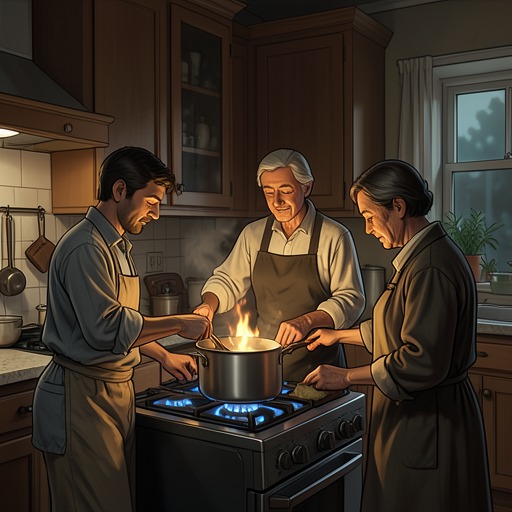
After Bailey’s funeral, visitors bring so many hams to the Walker home that they fill the refrigerator and freezer and crowd the kitchen surfaces. Uncle Big receives the mourners at the door, thanks them, and eventually turns the surplus into a distribution effort, aiming to get a ham sandwich to everyone within twenty miles. His exaggerated responses to each new delivery become a private source of laughter for Gram and Lennie, offering a brief release without diminishing the reason the visitors have come.
He also tends directly to Lennie and Toby Shaw. Finding them asleep on the grass, he wakes them with theatrical humor, brings a cooler, and helps them to their feet. He embraces Toby, asks how he is holding up, and keeps a hand on his shoulder when Toby admits he is not doing well. With his other hand on Lennie, Uncle Big offers the pair a shared principle: grief cannot be bypassed, and all of them must move through it. The comfort is physical as well as verbal, expressed through his touch and his readiness to help them back into the house.
Character and Narrative Significance
Uncle Big’s comic scale—his booming voice, handlebar mustache, and grandly improvised comparisons—does not make him emotionally distant. Instead, humor becomes one of the household’s ways of surviving the aftermath: the hams are both an unwieldy practical problem and an occasion for Lennie and Gram to share an inappropriate giggle. His capacity to make care concrete, through food, embraces, and attention to the houseplant, contrasts with the unmanageable facts of bereavement.
His own heartbreak gives that care a reciprocal dimension. Gram brings him into the home after his fifth wife leaves, and he in turn helps hold the household together after Bailey’s death. The novel presents him as an eccentric rather than a solemn authority, but his eccentricity is inseparable from his usefulness: he experiments, feeds people, makes them laugh, and acknowledges that grief is something the family must face together.